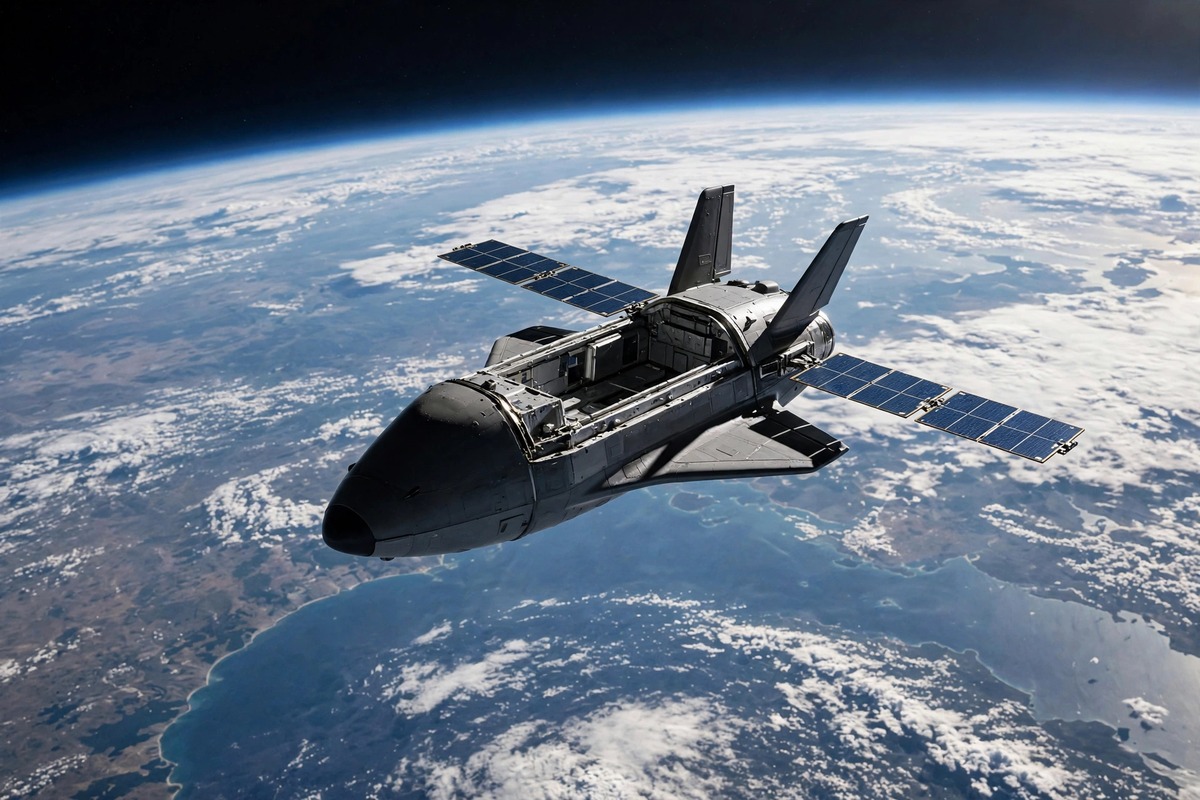
A new American intelligence report displays a sharp orbital photograph of a Chinese test vehicle that closely echoes the design of the U.S. Space Force’s X-37B.
The Defense Intelligence Agency included the image in its latest assessment of challenges in space. It shows a compact, shuttle-shaped craft with modest wings, two vertical tail fins, an open bay, and solar panels projecting from the rear. Compared with the X-37B, those features create a striking visual resemblance.
That visual raises a bigger question than simple appearance. What is the Chinese craft designed to do, and which vehicle is it? The DIA report identifies two main Chinese spaceplane models, Shenlong and Tengyun, but does not say which one appears in the photograph. The image invites comparison while leaving the craft’s identity unresolved.
Vantor, formerly Maxar Technologies, told TWZ that its WorldView-3 satellite captured the scene on May 28, 2024, from a distance of just under 56 miles. Vantor also reported that another satellite was attached at the vehicle’s rear, with its structure and solar arrays visible. The payload-bay doors were open when the photograph was taken.
The observation is part of a longer Chinese test program. Since 2020, China is understood to have flown this spaceplane model four times in orbit. Its most recent launch came on February 7. The report does not provide enough detail to connect the photographed craft to a specific launch, so the picture documents the design without settling its mission history.
The DIA’s broader explanation shows why the design matters. Reusable spaceplanes can maneuver more freely than traditional satellites and may suit missions that conventional spacecraft cannot handle as well. Such systems are difficult and expensive to develop, but recovering, refurbishing, and flying hardware again could reduce the cost of spaceflight. That makes the Chinese program important even before analysts know exactly what this particular vehicle is doing.
Why It Matters
For people tracking the military and security side of space, the image turns an abstract competition into something concrete. A reusable craft with maneuverability and an open payload bay cannot be understood as just a static object in orbit. It may support tasks that differ from those associated with a conventional satellite, although the photograph does not show what the Chinese vehicle actually did.
The resemblance should also be handled carefully. The image does not prove Chinese engineers copied the American design, and it does not identify the Chinese model. What it does establish is why analysts are paying attention: a similar shape, repeated orbital missions, and reusable hardware make the program more consequential than a one-off visual comparison.
The potential cost benefit broadens the stakes. If reusable systems can be recovered, refurbished, and flown again, they could support a more sustainable space effort, according to the logic described in the report. But the attached spacecraft’s purpose, the photographed vehicle’s exact mission, and the reason for the resemblance remain unresolved. The earlier NBC News report mentioned by the source may be relevant, yet the available material does not explain how.
For now, the evidence supports a clear but limited conclusion: China has a reusable spaceplane whose photographed shape closely resembles the American X-37B, while the report stops short of naming the Chinese model or explaining its mission. The picture makes the resemblance visible, but it does not by itself answer why the two designs look so much alike.
Source: The Liberty Daily