
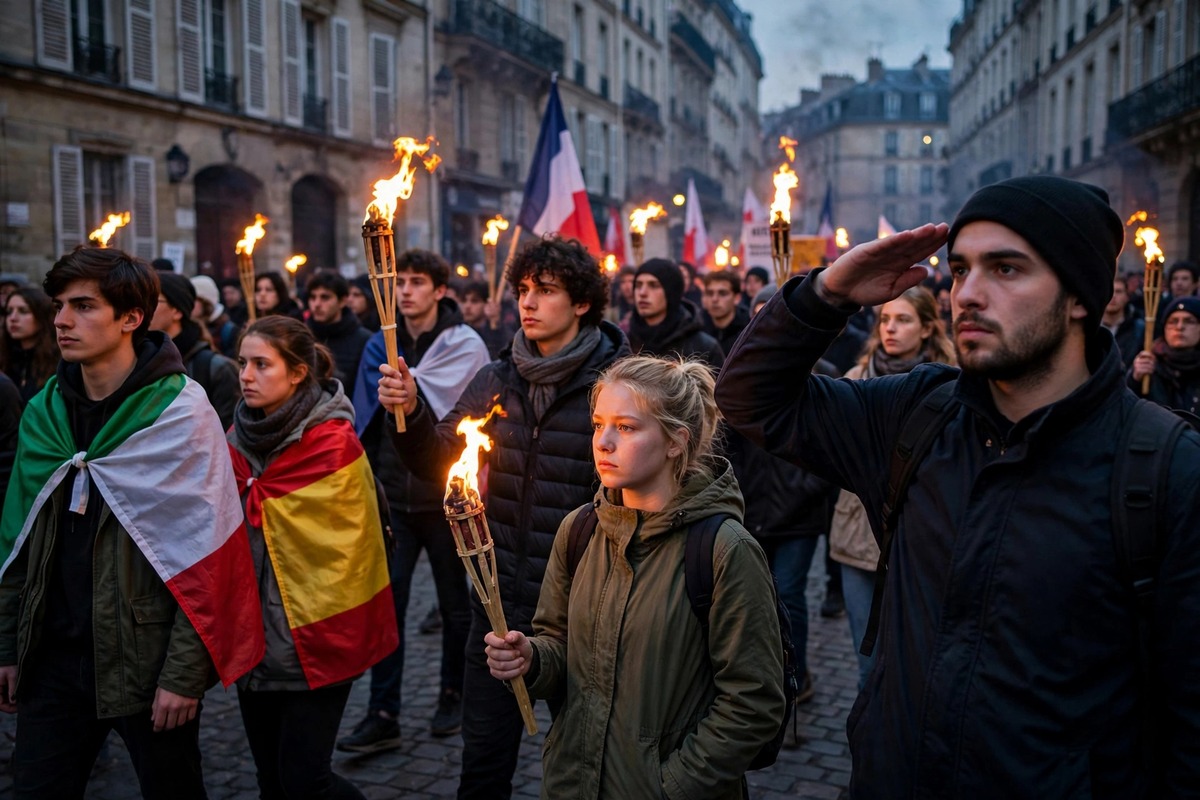
Europe’s political establishment is confronting a nationalist backlash over immigration, with young Europeans marching in Italy, Spain, and France for tighter borders and an end to mass migration. The demonstrations draw both mainstream conservatives and openly fascist organizations, making the reaction harder to classify.
Some attendees carry torches or perform Roman salutes, while others are nationalists focused on border policy rather than authoritarian symbolism. That distinction is central: public frustration with immigration exists alongside efforts by extremist groups to exploit it.
The European Council reported that asylum requests in the European Union reached more than 1.3 million in 2015, compared with roughly 260,000 in 2010. The council also counted approximately 1.8 million detected irregular crossings during 2015, as wars in Syria, Iraq, and Afghanistan contributed to the pressure.
First-time applications fell during the COVID-19 pandemic before reaching about 1.05 million in 2023, according to Eurostat. They later dropped to approximately 669,400 in 2025. The bloc also hosted millions of Ukrainians displaced by Russia’s invasion under temporary protection, according to the European Council.
The word fascist has also been aimed at conservatives. George Finch, a Reform UK council leader in Britain, alleged that he was called a “fascist” before an assault, The Guardian reported. In Germany, a Guardian opinion column presented opposition to the AfD as part of a fight against fascism. A German court later blocked authorities from labeling the entire party a confirmed extremist organization while a final decision remained pending.
These arguments are unfolding alongside unrest. The Associated Press reported looting in Milan, burned vehicles, and the fire at Limoges’ historic city hall during October protests. Some demonstrators were also alleged to have carried firearms, with the report describing that conduct as crossing into terrorism.
Milan then supplied a prominent display of extremist imagery. Reuters and ANSA reported that approximately 2,000 people marched on April 29 with Italian flags and torches, ending with synchronized Roman salutes. Video from a far-right account on X was corroborated by another view published by La Stampa.
The procession honored Sergio Ramelli, an 18-year-old activist connected to the Italian Social Movement’s youth organization. Far-left militants attacked him, and he died in 1975. Marchers moved in columns toward a memorial on Via Paladini, where a ceremony honored fallen comrades. Activists associated with neo-fascist groups CasaPound Italia and Lealtà Azione took part, and a banner also honored the dead.
ANSA reported that the march ended with imagery tied to Benito Mussolini’s dictatorship. Milan Mayor Giuseppe Sala condemned the salutes while recognizing Ramelli as a victim of Italy’s historic political violence.
Why It Matters
These events matter because Europe’s immigration dispute is producing very different political reactions in the same public space. Many people want tougher borders, while some organizations are using imagery tied to authoritarian rule. Treating those positions as identical can obscure the difference between policy demands and extremist symbolism. Yet ignoring the symbolism can also minimize why the Milan procession drew condemnation. The central stake is whether legitimate public frustration can be discussed without letting groups tied to fascist history claim ownership of the broader nationalist response.
The story also shows how the dispute has spread across borders and institutions. Italy’s street demonstrations sit alongside unrest in France, demonstrations in Spain, Germany’s fight over the AfD’s classification, and the accusation involving a Reform UK council leader in Britain. That range means the conflict is not only about arrival figures. It is also about who gets to define acceptable opposition, how governments respond to public anger, and whether the fascist label is used precisely or as a broad political weapon.
What remains unresolved is whether European leaders can separate those issues instead of allowing them to collapse into one confrontation. The account presents pressure from immigration, extremist groups seeking visibility, and broad accusations that can be challenged in court or disputed by the people who receive them. That uncertainty is why the Milan images matter beyond a single memorial march: they bring border policy, national identity, historical memory, and the boundaries of political speech into the same argument.
Source: The Liberty Daily
