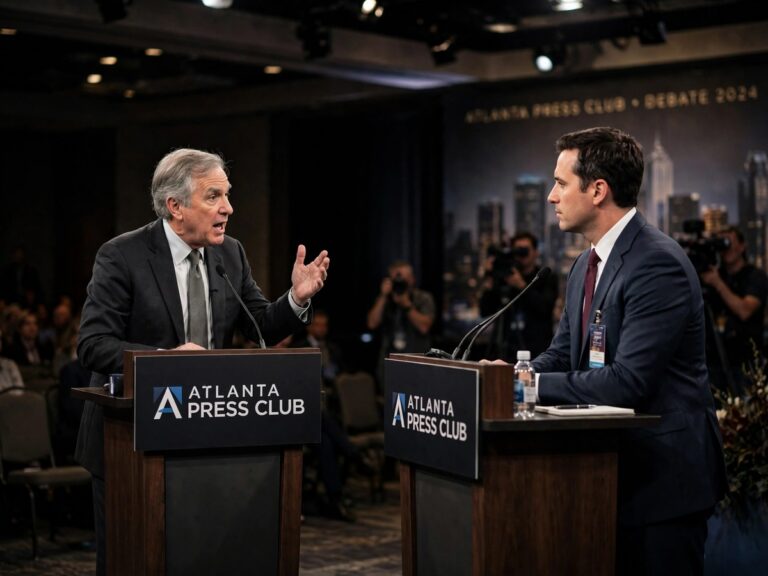
Palmer Luckey delivered an unexpected defense of Donald Trump at The New York Times’ DealBook Summit, challenging the Ukraine framing Andrew Ross Sorkin brought to their conversation. Sorkin asked the Anduril Industries co-founder about Ukraine, rebuilding the American arsenal, Trump’s remarks about Vladimir Putin, and what it means to support democracy.
Luckey refused the premise that a corporate leader should set the terms of American foreign policy. He stressed that the United States is a republic, not a democracy, and said executives like him should be restrained. His blunt analogy was that he should be kept “like a dog on a chain.”
That response carried extra weight because Anduril makes military technology, including unmanned systems, and has dealings with Ukraine. Luckey was discussing a war connected to his business while arguing that people in his position should not control the nation’s decisions.
He then shifted the focus from Trump to Europe. Luckey said Trump had been left with an impossible situation because the continent was not prepared for the war. He recalled Trump’s earlier criticism of European leaders whose pipeline plans increased their energy dependence on Moscow, making it harder for them to say no to Russia.
Luckey also said Germany had sent more money to Russia than to Ukraine since the war began. He pushed back on the idea that European nations were on the verge of freezing, saying they had raised their thermostats by a degree and could have worn a sweater instead. His larger point was that the burden of supporting Ukraine was not being shared evenly.
There was another complication. Luckey said Anduril had tried to sell equipment to Ukraine before the invasion, but the U.S. government’s assessment of the country was then harsh. He referred to it as a “corrupt s**thole,” a description that made the current pressure for uncomplicated support look very different from the earlier view.
A social media post sharing the video claimed Sorkin appeared to sink in his chair as Luckey challenged the assumptions surrounding Trump, Ukraine and Elon Musk.
You can literally see Andrew Ross Sorkin sink in his chair as he realizes Palmer Luckey is going to dismantle everything his political party believes about Ukraine, Elon Musk and Donald Trump pic.twitter.com/H72RX7Ig3T
— Ian Miller (@ianmSC) November 21, 2026
Why It Matters
This exchange matters because it turns a familiar political argument into a question about responsibility. Luckey’s position, as presented in the interview, is that support for Ukraine cannot be separated from Europe’s preparation, its energy choices, or the earlier American judgment about Ukraine. That makes the dispute more complicated than a simple test of whether someone supports democracy.
The people caught in that dispute include Ukrainians seeking support, Europeans being pressed to do more, American officials weighing military resources, and corporate leaders deciding how openly to speak. Luckey also raises a boundary question: how much influence should a defense executive have over foreign policy when his company has business connected to the conflict? That question gives the interview stakes beyond the exchange itself.
The open issue is whether this blunt criticism changes minds or deepens the divide. Trump’s critics focus on the demand for support, while Luckey’s argument points to Europe’s weakness, prior energy dependence, and the difficulty of changing a position through public insult. The interview leaves that conflict exposed, with no easy answer about how policy, business interests and political influence should fit together.
Luckey’s closing point was blunt: “If people think that the right way to influence Trump is for people, like me, to throw him under the bus and say, ‘yeah, what a f**king idiot,’ they have not been watching how anything works for the last 10 years.” He argued that public insults would not persuade Trump. Instead of endorsing a simple attack on the president, Luckey challenged the strategy behind it, leaving Sorkin’s question aimed at Trump with a much broader critique of the Ukraine debate.
Source: Townhall