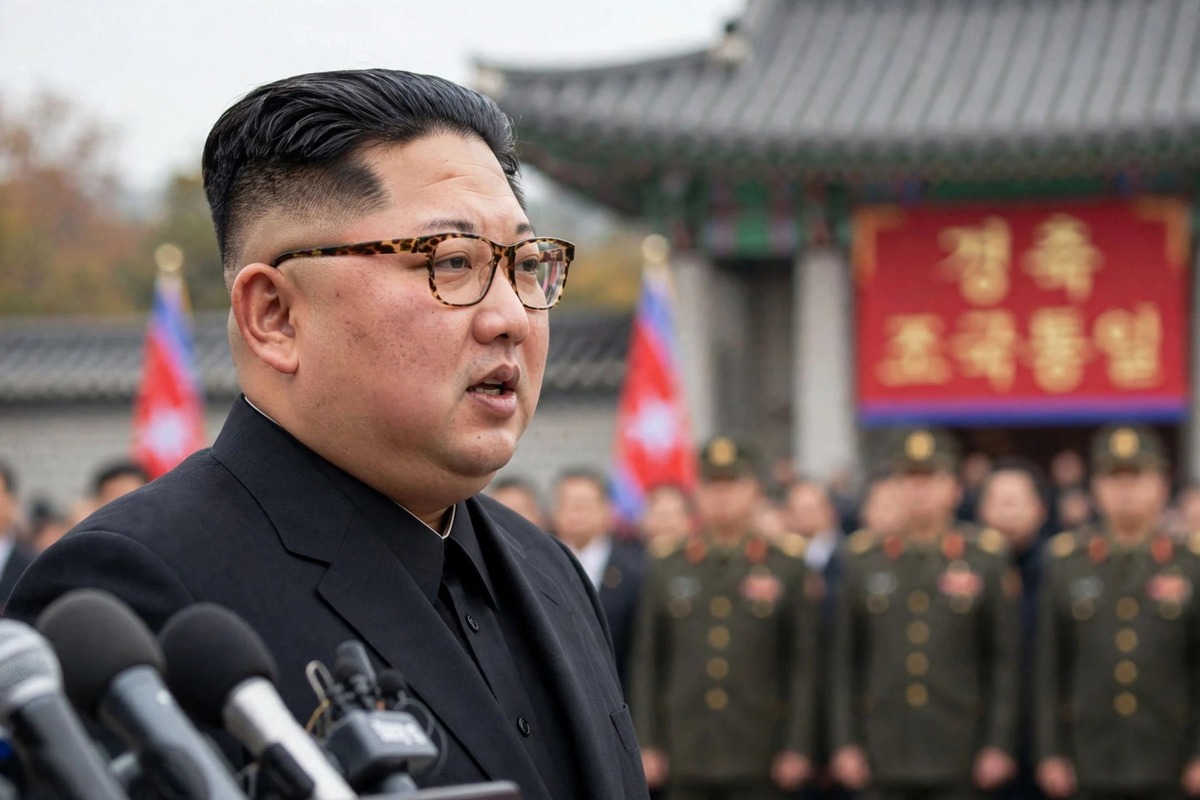
Kim Jong Un watched a suicide drone dive into a mock American M1 Abrams during a North Korean weapons demonstration Thursday, ending in an explosion that engulfed the target.
The display went far beyond one drone strike. North Korea presented more than 30 types of unmanned aircraft, launched cruise missiles, and fired heavy rocket artillery as Kim demanded faster progress in drone warfare.
Photos released Friday show a slim, propeller-driven loitering munition descending toward a sand-colored Abrams replica. North Korean authorities did not disclose the weapon’s range or warhead size, leaving its battlefield reach uncertain.
The aircraft’s cross-shaped wings and rear propeller resemble the Israeli-designed Hero-400, according to a defense report. That visual similarity does not prove that the North Korean drone has the same capabilities. The U.S. Marine Corps fields the Hero-400, while American forces in South Korea use Abrams tanks.
North Korean strike drones & Lancet loitering munitions being used on practice targets resembling ROK Army DMZ Guardposts, K9 howitzers & US Army M1 Abrams.
We currently have some forward-positioned AD assets like the K30 Biho along the DMZ, but their C-UAS ability is lackluster. pic.twitter.com/8PCFRKhTSm— Korea Defense Blog (@Korea_Defense) October 30, 2026
North Korea also displayed FPV attack quadcopters and inexpensive expendable drones. Several systems appeared to use fiber-optic control, with a cable connecting the aircraft to its operator rather than a radio link. That setup can make conventional radio-frequency jamming less effective and has become increasingly common in Ukraine.
Other aircraft borrowed familiar designs. One flying-wing drone resembled the American RQ-170 Sentinel and Russia’s S-70 Okhotnik, though its actual stealth performance remains unproven. The Saetbyol-4 surveillance drone looked like an RQ-4 Global Hawk, while the armed Saetbyol-9 resembled an MQ-9 Reaper and was photographed launching an air-to-surface missile.
Kim said gaining complete superiority in drone technology is necessary as warfare changes and urged researchers to expand the use of artificial intelligence in unmanned weapons. North Korean state media claimed the suicide drones, air-to-surface missiles, and cruise missiles hit designated island targets with one-hundred-percent accuracy. That claim has not been independently verified.
Why It Matters
This demonstration matters because it combines several parts of Pyongyang’s military message in one public display: low-cost attack drones, larger surveillance aircraft, guided systems, artillery, and missiles. The mock Abrams target gives the event a clear focus, especially because American forces operate Abrams tanks in South Korea. But the images show intent more clearly than they show capability.
For South Korea and the United States, the most important questions are practical. How far can the featured munition travel? What warhead can it carry? Can the flying-wing design actually reduce radar visibility? And can North Korea’s accuracy claim be confirmed outside state media? Those answers would distinguish a public demonstration from a proven battlefield system.
The event also fits the broader pattern described in the source. Pyongyang is combining established firepower with newer unmanned tools while deepening military cooperation with Moscow and participating in Russia’s war against Ukraine. That makes the display relevant beyond the test site and raises questions about how cooperation and battlefield experience could shape North Korea’s next advances, without proving that any displayed system is ready for combat.
The weapons showcase carried a second warning. North Korea publicly demonstrated its 600 mm “Sniper” multiple rocket launcher, with photographs showing more than 10 launchers firing at the same time. South Korea’s Joint Chiefs of Staff also detected approximately 10 short-range ballistic missiles launched from the Wonsan area. The missiles traveled roughly 250 kilometers, marking North Korea’s 17th ballistic missile launch of 2026.
A South Korean military official said the launchers were likely part of the KN-25 family, which Pyongyang claims can carry tactical nuclear warheads. North Korea did not reveal the demonstration’s location, although visible structures suggested Wonsan-Kalma Airport. The broader military activity came as South Korean intelligence assessments cited in the source reported that more than 16,000 North Korean personnel had deployed to Russia since October 2024.
Source: The Liberty Daily