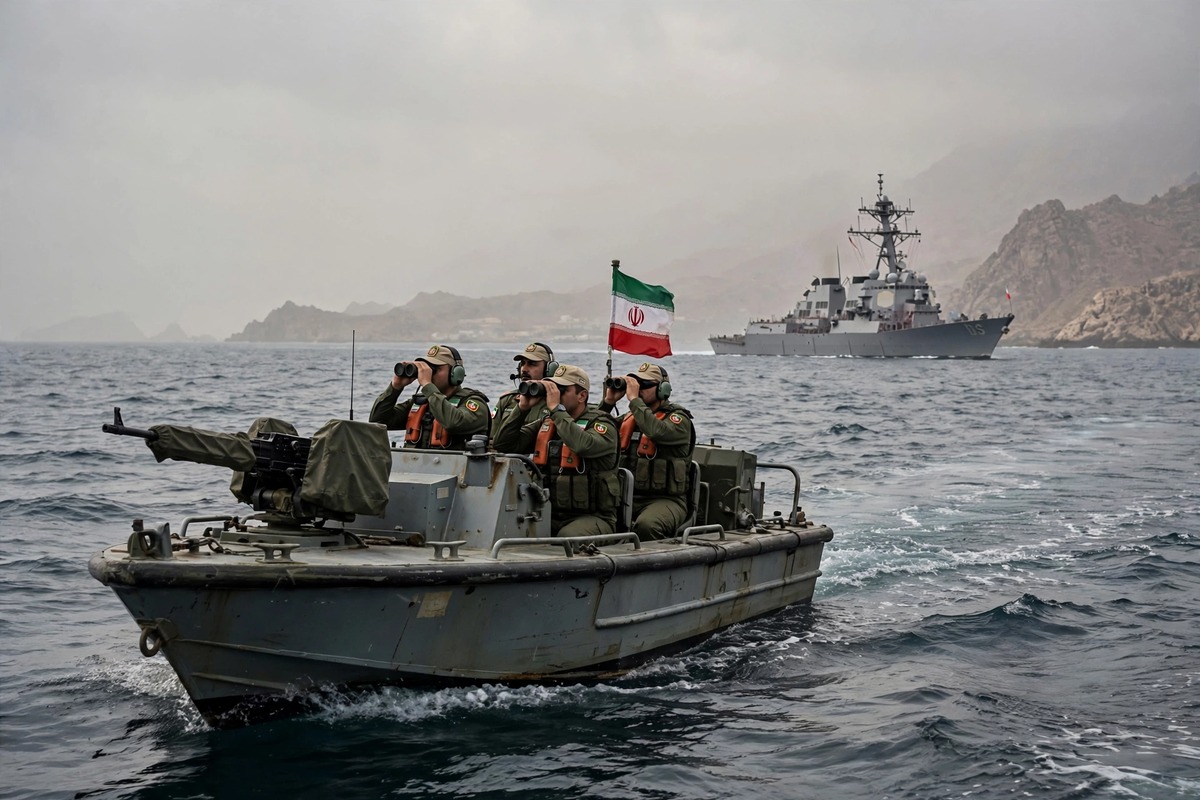
Iran’s Revolutionary Guard Navy has threatened to sink U.S. warships approaching the Strait of Hormuz, saying it is waiting for American vessels to reach the waterway’s entrance. The warning arrives as commercial shipping in and around the strait faces a surge of reported attacks.
Security data cited in the report lists attacks on at least ten commercial vessels since Sunday. Four were recorded Tuesday and six Sunday, producing the conflict’s largest daily total so far. The figures came from Vanguard, the International Maritime Organization, and UKMTO, the British maritime agency.
Iranian officials are not signaling a pause. Mohsen Rezaei, secretary of Iran’s Supreme National Security Council, told state television, “We target five or six of these every night.” He added, “Hormuz is under the control of the Islamic Republic.”
It appears that Trump has definitely decided to attack Iran after the midterms…
"Wait till you see what we do to Iran. We're gonna—we're gonna do a number. Wait till you see… We've had it." pic.twitter.com/b2swiiU1Cx
— Michael Snyder (@Revelation1217) October 14, 2026
The confrontation has also moved into mine warfare. The report says Iran began placing mines along the southern passage near Oman’s coast. Iran’s Revolutionary Guard Navy reported that a cargo ship sank after hitting one, the first sinking from a mine that Iran had acknowledged during this war.
There were also two separate incidents involving Singapore-registered cargo ships. Shipping officials said both were struck by unidentified projectiles while passing through the strait on Tuesday and Wednesday. One vessel went down, while the other reached safety. The entire crew of the sunken ship was evacuated, and officials reported no injuries. Singapore’s maritime authority condemned the attacks as unjustified violations of international law.
The financial damage could last beyond the immediate attacks. The report says a tanker can cost between $60 million and $140 million, while building a replacement can require nine to fifteen months after an order is placed. That means lost shipping capacity cannot be restored quickly, even if the violence stops.
BREAKING: Iran declares it will sink US aircraft carriers and kill their crews, and is waiting for US warships to approach the Strait of Hormuz "so that we can sink them. We are counting down moment by moment until this happens," per IRGC Navy commander Azmaei to IRNA.
For the…
— The Hormuz Letter (@HormuzLetter) October 14, 2026
President Trump has also raised the prospect of a new U.S. campaign. At a campaign rally, he said, “Wait till you see what we do to Iran. We’re gonna do a number. Wait till you see… We’ve had it.” The report interprets those remarks as a sign that he intends to act after the midterm elections, adding to Tehran’s preparations and the danger surrounding the strait.
U.S. DEPLOYS HUNDREDS OF TROOPS TO LATIN AMERICA AS ANTI-CARTEL OPERATIONS EXPAND
The Pentagon is deploying approximately 600 soldiers from the 10th Mountain Division to Latin America as Washington expands its military campaign against drug cartels, according to U.S. military… https://t.co/i9vXpjDjkH
— *Walter Bloomberg (@DeItaone) October 14, 2026
Why It Matters
The stakes extend well beyond the commanders trading threats. Crews face the immediate physical danger, while cargo owners and the operators of commercial vessels face the cost of damage, delays, and replacement. The source’s shipping figures show why the strait matters in practical terms: a ship lost today cannot simply be replaced tomorrow. Mines also create a threat that may remain difficult for crews to see or avoid, making the route more dangerous even when no new missile strike is publicly confirmed.
The wider concern is an escalating chain reaction. Repeated attacks on commercial traffic, a declared willingness to keep striking, and a U.S. promise of forceful action all reduce the room for talks described in the report. The open questions are whether the nightly threats become more attacks, whether another ship is lost, and whether either side steps back before an American warship is hit. The IRGC Navy’s message is direct: it says, “We are waiting for U.S. warships to approach the entrance to the Strait of Hormuz so we can sink them.”
Source: The Liberty Daily