
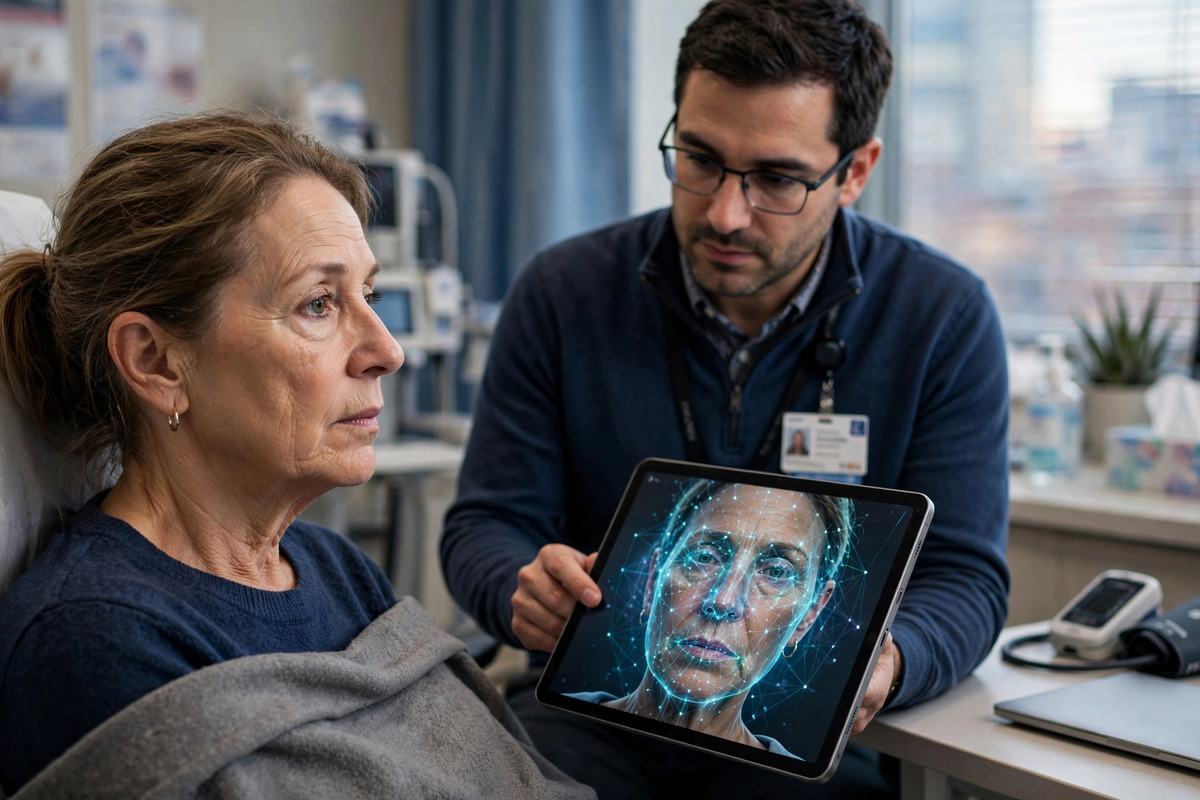
A new AI model can use a facial image to estimate biological age and predict a cancer patient’s survival prospects, researchers say.
Developed by scientists at Mass General Brigham in Boston, the system is presented as a non-invasive way to detect clues about how a person’s cells, tissues and organs are functioning. The study appeared in The Lancet Digital Health on Oct. 19, turning an ordinary selfie into a possible health signal.
The model, called Foundation Artificial Intelligence for Health Recognition-Face, or FAHR-Face, learned from upwards of 40 million face images. Researchers then adapted it for two jobs: estimating biological age and forecasting survival among cancer patients.
Those images came from WebFace42M, an online collection containing 42 million facial-recognition images tied to 2 million identities. The dataset was developed by research teams from Tsinghua University, Imperial College London and XForwardAI. For the cancer application, researchers fine-tuned the system with 34,363 photographs of cancer patients from a research center in the Netherlands.
The survival results drew particular attention. Of the 122 patients the model placed in a high-risk group, 52.5% died during the 90 days after the assessment, according to the study. Researchers also said the models performed better than an earlier age-estimation system when used to forecast survival.
Raymond Mak, a Mass General radiation oncologist and study author, said the two functions examine different parts of the face. Biological-age estimation focuses on the temples, forehead, area above the eyes and the line extending from the nose toward the mouth. The mortality model pays closer attention to the bridge of the nose and the region beneath the eyes, he explained to CNN.
That finding connected the technology to an observation from medical history. The same general facial features were discussed by Hippocrates in the Book of Prognostics, written around 400 B.C., as signs associated with approaching death. Mak said it was striking that the algorithms appeared to echo that old observation even though they had never been taught the ancient text.
The study describes the work as the first reported AI system able to predict cancer-patient survival directly from a facial photograph. Mak said the model learned from photographs paired with a person’s age or survival outcome, not from Hippocrates or any other historical writing.
Why It Matters
This research matters because it pushes medical AI beyond recognizing a visible feature or sorting an image. It suggests that a face may carry signals connected to biological aging and serious illness, even when a person is not undergoing an invasive test. For cancer patients and their doctors, that possibility could make risk assessment faster and easier to access. But the prediction still needs to be understood. The study shows what the model can identify, not why those facial patterns are linked to survival or how the result should influence treatment.
The training path also explains why the promise comes with difficult questions. A system learned from a huge collection of internet facial photographs and then refined with cancer-patient images may produce an intriguing signal, but its limits cannot be ignored. Patients need clarity about how such a tool would be used, doctors need to know how much confidence it deserves, and everyone affected needs safeguards around highly personal images. The central tension is clear: a quick, non-invasive warning could be valuable, but it must remain a risk estimate rather than a final verdict.
Source: The Liberty Daily