
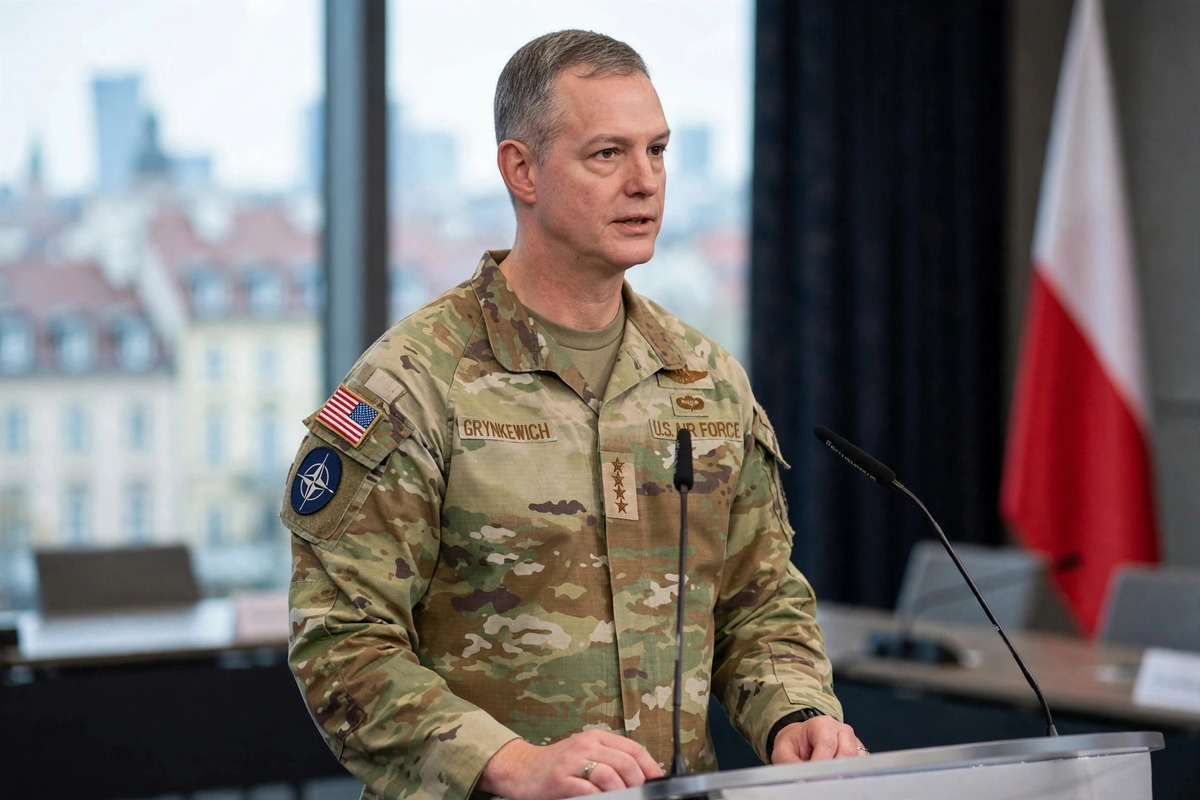
NATO’s top military commander has publicly sketched how the alliance would respond to a future Russian attack on its eastern flank: stop the initial advance, disrupt the force behind it, and dismantle the systems that keep it operating.
US Air Force General Alexus Grynkewich presented that “theory of victory” at the Warsaw Security Forum. He said NATO would “block, blunt and break” an assault on member territory, making it futile while trying to prevent a wider, prolonged war. He also insisted the alliance was prepared to fight immediately if attacked.
Grynkewich said a conflict is not imminent or inevitable. Yet he acknowledged that populations across the alliance are nervous, which is why he brought a plan classified for months into public view. His stated goal was to reassure the alliance’s one billion citizens that members know their roles and must act together. Nuclear war loomed over the discussion, but it was not the focus of his speech.
The Response Would Move Through Three Stages
The first phase would use ground forces to stop an initial territorial grab while air, naval, space and cyber capabilities secure control of the battlefield. If the assault continued, sensors and drones would slow its momentum. A final phase would apply sustained pressure across multiple domains against logistics, communications and command structures.
That pressure would cut supplies and isolate commanders. The objective would be to neutralize the invasion force and the systems directly supporting it, not to pursue Russia’s broader strategic defeat.
The Plan Reaches Behind the Front Line
Grynkewich said that if an adversary kept attacking or committed reserve forces, NATO would target the entire warfighting system, including combat units and the structures that support, sustain or control them. That language suggests possible missile strikes deep inside Russia, including against command-and-control centers.
Bloomberg’s summary described a response that could blockade, degrade and strike adversary forces, while neutralizing systems aimed at NATO’s combat assets. It also pointed to a mix of high-end precision-guided weapons and large-scale, cheaper systems that could be deployed broadly. Grynkewich framed that capability as deterrence, saying it would strengthen alliance unity and weaken Moscow’s ability and willingness to continue.
NATO's SACEUR General Alexus Grynkewich:
We know how we will fight if a fight comes to us. And we know we will win.
And together we will ensure that any adversary who considers attacking our alliance reaches the only conclusion that matters: Today is not the day. pic.twitter.com/tt1NfjeaX7
— Clash Report (@clashreport) October 12, 2026
Robots Would Help Hold the Eastern Flank
A Wall Street Journal report added detail about a Ukraine war-inspired “autonomous zone” on the eastern flank. The concept would use drones and ground robots to slow a Russian assault without extensive allied casualties, while long-range missiles hit Russian command posts. It was designed around concern that Russia’s geography and large defense industry could let it mass forces against Baltic states, Poland and other NATO members before the alliance assembled a robust response.
NATO's SACEUR General Alexus Grynkewich:
The risk of a major attack on NATO territory right now is actually relatively low.
The reason is Vladimir Putin's war is ongoing in Ukraine, and his military is unfortunately engaged in that conflict.
That force is not available to… pic.twitter.com/957fekR6JR
— Clash Report (@clashreport) October 12, 2026
Why It Matters
This matters because the commander is trying to solve two problems at once. NATO must convince exposed member states that an attack would meet a coordinated response, but it also wants to signal that its response has a defined limit. That balance is central to the public message: deterrence should prevent war, not become a promise of an open-ended campaign. The plan’s emphasis on shared action also shows that the alliance’s strength would depend on many military domains and national contributions working together, rather than on one weapon or one battlefield.
For civilians and leaders on the eastern flank, the most important question is whether this layered approach could stop an advance quickly enough to avoid a larger conflict. The use of drones, robots, cyber tools and long-range strikes also raises a difficult issue the speech did not resolve: how far a defensive operation could expand into Russian territory before the risk of nuclear escalation grew. Grynkewich’s remarks offer reassurance, but they do not remove that uncertainty. They make the alliance’s intended response clearer while leaving the consequences of escalation at the center of the debate.
The Public Message Has Two Targets
Grynkewich’s message was aimed at nervous populations inside the alliance and any government weighing an attack. NATO wants citizens to believe it is ready, while persuading a potential aggressor that an assault would fail. The public outline offers reassurance, but the most sensitive details of the earlier classified plan remain undisclosed.
Source: The Liberty Daily
