
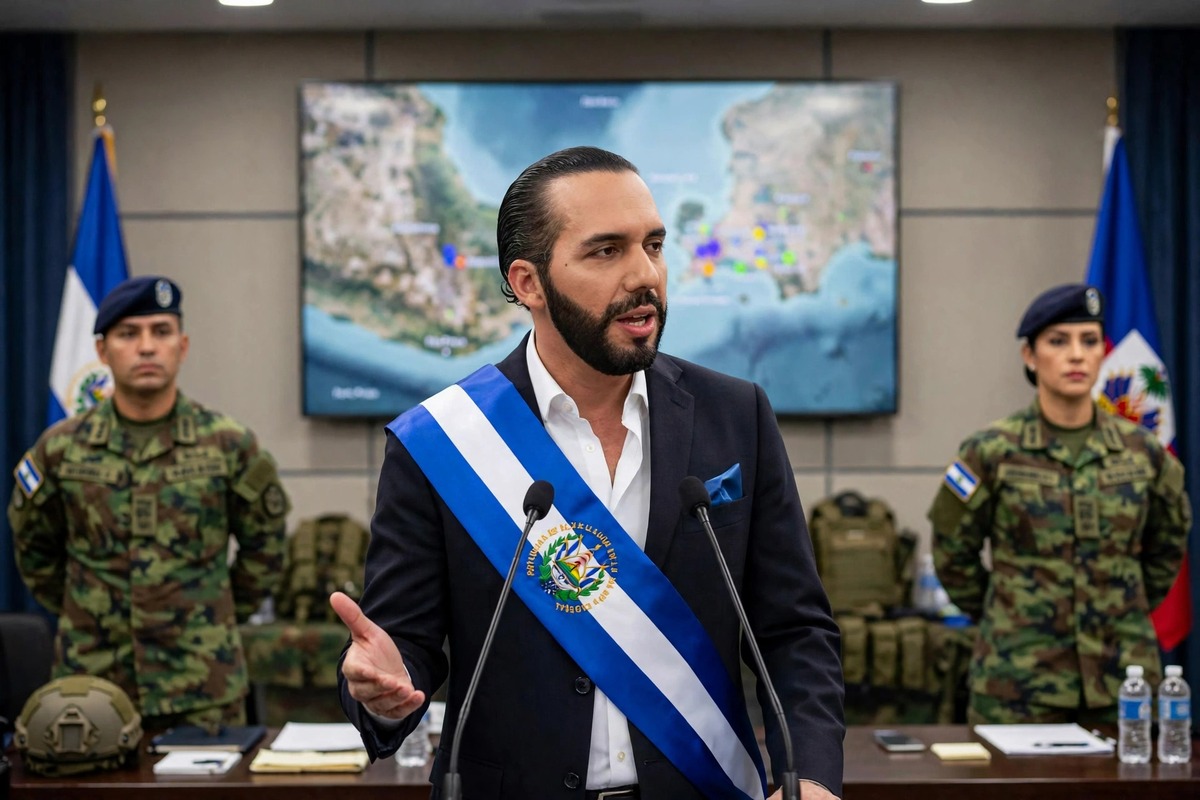
El Salvador has launched a mission in Haiti to recover four Salvadoran aviation technicians after gangs allegedly kidnapped them, President Nayib Bukele announced Wednesday.
The technicians were part of an international mission and were not serving as combatants, according to Bukele. He said they had gone to a market for food and were taken while heading back. Their assigned work included medical evacuations, placing the alleged abduction against personnel supporting an operation already meant to help people in Haiti.
Bukele said Salvadoran forces were trying to bring the men home alive. He also warned the gangs that the action already carried out was minor compared with what could follow if any captive were harmed.
In a post on X, Bukele gave the captors a way to avoid an escalation: free all four men unharmed, and conditions could return to the way they were before the alleged kidnapping. He wrote the warning in Haitian Creole, with an English translation provided on X.
Pou chèf gang yo ak manm gang yo k ap kenbe kat konpatriyòt nou yo an otaj ann Ayiti:
Mesye nou kidnape yo pa konbatan. Yo se teknisyen nan domèn avyasyon ki fè pati misyon nou ann Ayiti, nan kad yon misyon entènasyonal. Misyon nou an gen sèlman pilòt ak pèsonèl teknik, ki gen… pic.twitter.com/BNKbWTAQQp
— Nayib Bukele (@nayibbukele) October 21, 2026
The operation extends El Salvador’s existing role in Haiti rather than representing a completely separate deployment. Salvadoran troops are already assigned to the multinational Gang Suppression Force, the country’s Defense Ministry said.
That mission includes moving wounded people for treatment, searching for and rescuing people, conducting patrols from the air, and assisting Haitian police. It also involves aircraft along with military and civilian personnel, according to information from El Salvador’s Legislative Assembly.
The U.N. Security Council authorized the force in September 2025. Its mandate allows as many as 5,550 personnel, while Salvadoran lawmakers approved an initial 12-month extension of their country’s participation beginning October 2.
Why It Matters
This story matters because the alleged kidnapping puts a human cost on an international mission often discussed through forces, mandates and security duties. The four technicians were described as noncombatants, and their medical evacuation work makes the reported incident especially significant for people who depend on that support. It also shows how quickly a mission intended to assist Haitian authorities can become a direct test of another country’s willingness to protect its own personnel.
For Haiti, the warning raises the stakes around cooperation between foreign personnel and Haitian police while armed gangs remain capable of threatening people connected to the mission. For El Salvador, the episode tests whether its overseas deployment can continue rescue, patrol and police-support duties without provoking a larger confrontation. Bukele’s message turns the alleged kidnapping into both a hostage crisis and a measure of how the mission responds under pressure.
The central questions remain unresolved. The public statement did not name the gang involved, say how large the Salvadoran rescue force was, or confirm that the technicians had been freed. Those missing details matter because they would show whether the operation was still underway, had secured a safe release, or had entered a more dangerous phase. Until that information is provided, Bukele’s warning is both a promise to recover the men and a threat of escalation.
His Wednesday update gave no name for the gang, no figure for the Salvadoran contingent, and no confirmation that the four technicians were free.
Source: The Liberty Daily
