
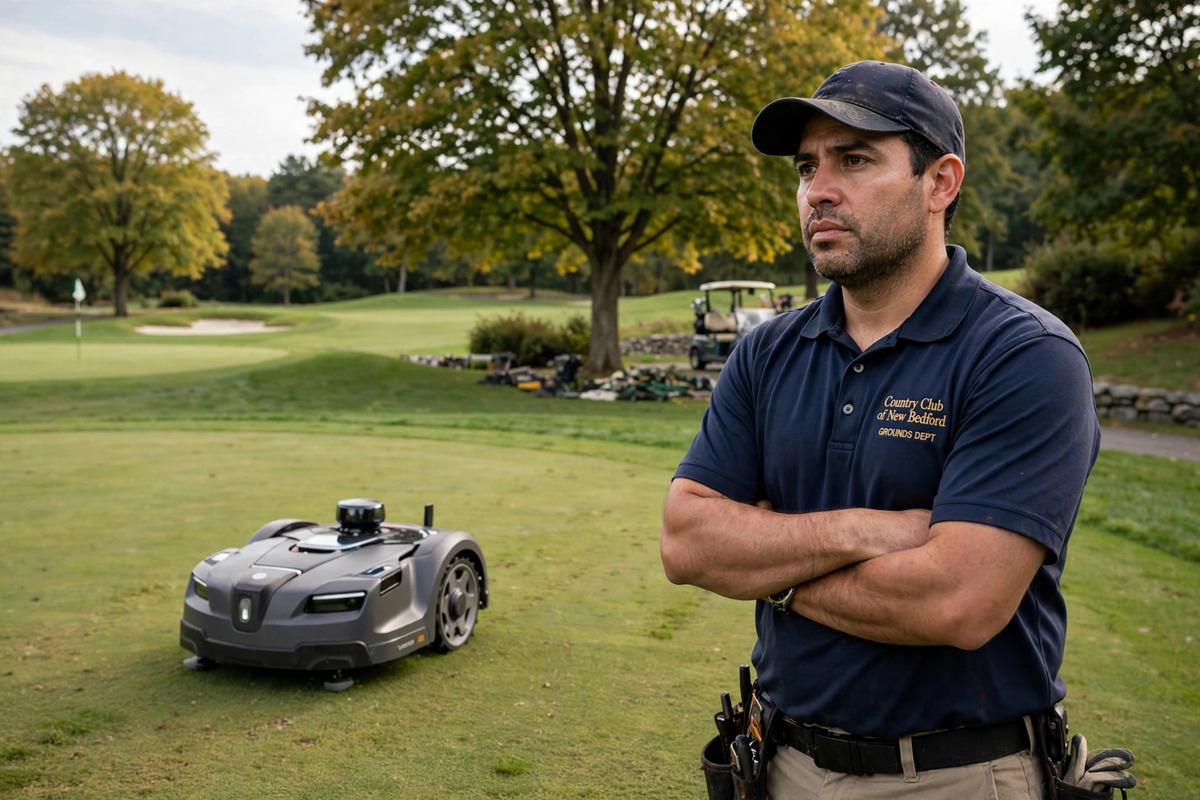
Autonomous mowers are already operating on American golf courses, and their arrival is forcing a direct question about the future of groundskeeper work.
Reports place the machines at Florida’s Four Seasons’ Tranquilo Golf Club and Michigan’s Barton Hills Country Club. Maryland’s Baltimore Country Club and Massachusetts’ Country Club of New Bedford have also joined the list. Their spread shows that course operators are testing whether autonomous equipment can handle routine maintenance while staff take on other responsibilities.
Walter Garcia, an assistant superintendent at the Country Club of New Bedford, described the system as similar to a Roomba. Staff provide instructions, establish the mower’s route, and let it map the area. Workers then continue monitoring the machine to ensure everything operates properly.
That detail matters. The mowers can complete work on their own for stretches, but they are not being treated as completely unattended replacements for human crews.
The equipment also carries a significant price range. Some autonomous electric mowers cost several thousand dollars, while others approach $200,000. New Bedford purchased two units priced at $200,000 each, making the club a prominent example of physical AI appearing as a ground robot instead of a humanoid machine.
The appeal for course managers is practical. These machines can support more consistent playing conditions and lower maintenance costs. Some courses have also said automated mowing gives groundskeepers more time for detailed work, such as repairing ball marks on greens and removing weeds.
That benefit changes the immediate debate. Instead of simply asking whether robots will replace workers, course operators are deciding how much routine mowing can be shifted to machines and how employees should use the time that automation creates.
Still, the labor question remains. Tens of thousands of groundskeepers work across the golf industry, and equipment that handles more repetitive mowing could eventually affect staffing needs. For now, the approach described by the courses using these systems is to redirect workers toward more delicate maintenance rather than eliminate their jobs outright.
Why It Matters
The significance reaches beyond whether a mower can cross a fairway without constant human steering. Course owners are weighing a costly purchase against steadier playing conditions and lower expenses, while groundskeepers may see their daily work move away from repetitive mowing and toward more precise maintenance. That can make a crew more useful in the short term, but it also changes the skills and tasks that employers may value. Golfers are affected because the stated goal is better upkeep, while workers are affected because the same efficiency could reduce the need for routine labor.
The bigger issue is that the transition has already started, even though its final shape is unclear. Human monitoring remains necessary in the examples provided, which means these machines have not fully removed workers from the process. Yet their consistency and cost advantages give operators a reason to keep expanding their role. The unresolved question is whether redirected duties will remain enough to support current staffing levels, or whether routine automation will eventually lead to fewer groundskeeper positions. The source shows an industry testing a new balance between physical AI and human care.
For now, the clearest outcome is a reshuffling of duties. Robots handle more repetitive mowing, while groundskeepers are directed toward ball marks, weeds, and other detailed work. But the possibility of reduced staffing is no longer theoretical for course managers. The machines are already on the grounds, and the industry’s next decision is how much human labor should remain around them.
Source: The Liberty Daily
