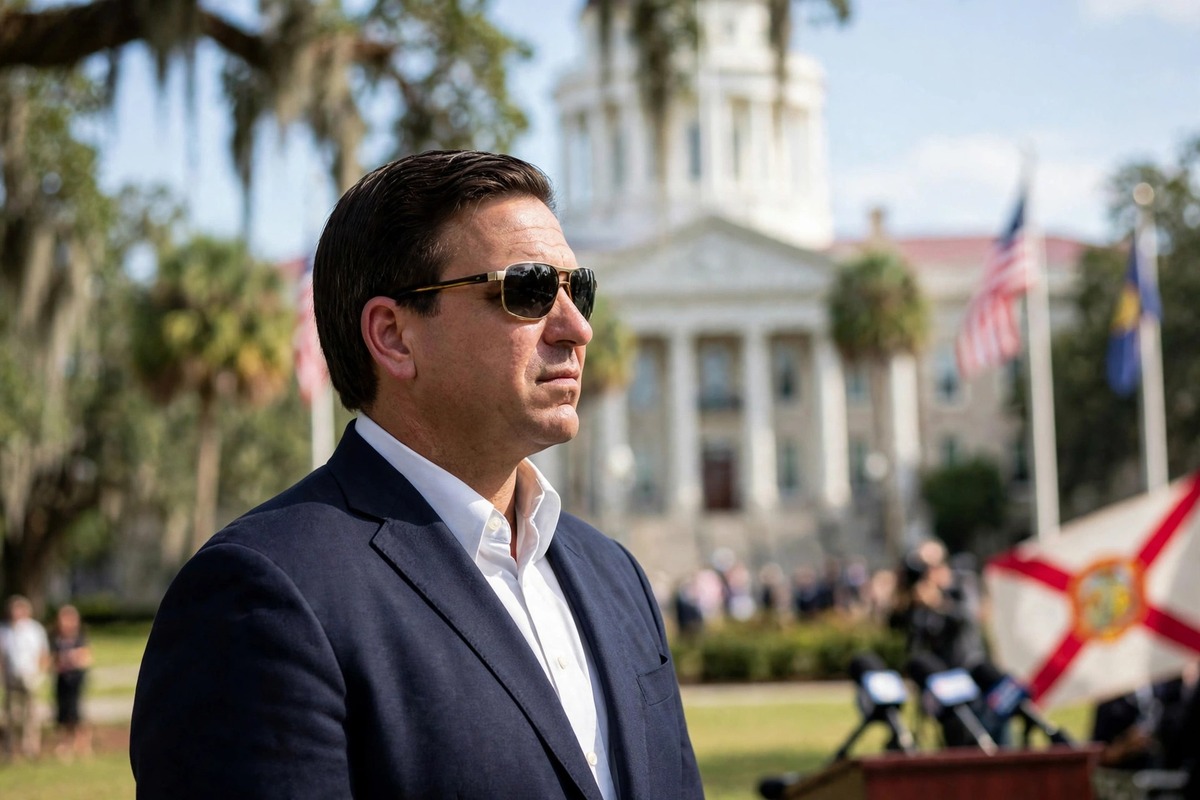
Gov. Ron DeSantis says Florida stayed Republican while Texas went blue, and the comparison turns on three major differences.
The states share Republican leadership, prosperity and large populations, yet the national blue surge produced sharply different results. DeSantis described the broader election as a political meteor strike that hit red and blue states alike, while Florida alone among the nation’s ten largest states kept Republican control.
He treated Texas as Florida’s main Republican rival. Texas Republicans lost a widely watched U.S. Senate race and, in DeSantis’s assessment, suffered much broader losses. The question is why similar states responded so differently.
Florida put affordability directly on the ballot. Economic concerns were central in both states. Exit polls showed the economy as the top issue for four in ten Texas Senate voters and 37% of Florida Senate voters. But among Florida voters who ranked it first, 55% chose the Republican candidate, compared with 40% in Texas.
Amendment 3 offered a concrete reason for that difference. It stood at 62% to 38% in the current count and would exempt the first $150,000 of a property’s value from city, county and special district taxes beginning in 2027. The exemption rises to $250,000 in 2028, while school property taxes still apply.
Florida TaxWatch gave a homeowner example of $1,035 in savings in 2027 and $2,085 in 2028. DeSantis said the measure may also have brought voters to the polls, with some supporting it before voting Republican farther down the ballot.
That made affordability more than a talking point. It put a visible tax proposal in front of voters who already viewed costs as a top concern.
Florida’s Cuban voters created another major split. Giancarlo Sopo, a communications strategist and National Review writer, argued that Cuban voters stayed with the GOP. Exit polls showed 56% backed the Republican governor nominee, while other Hispanic groups in Florida went roughly 60-40 in the opposite direction.
Sopo’s counterfactual was dramatic: if Cubans had voted like other Hispanic groups, he said Florida might have had a Democratic governor and possibly senator, while Republicans would have held three fewer House seats.
Juan Wulff’s Miami-Dade analysis showed the same pattern at the precinct level. Areas under 10% Cuban favored Nixon by 35.7, while areas at 70% or more Cuban favored Moody by 32.4. The county still shifted D+18.6 from 2024, but heavily Cuban areas likely slowed that movement.
Cuban Americans Kept Florida Red
Last night Cubans stayed with the Republican Party and prevented Florida from becoming a blue state. According to exit polls, 56% supported the GOP nominee for governor. Every other Hispanic group in Florida went 60-40 the other way. Had Cubans… pic.twitter.com/SCSOUXuhRp
— Giancarlo Sopo (@GiancarloSopo) November 4, 2026
In Miami-Dade, the more Cuban the precinct, the more Republican the vote:
Under 10% Cuban: 🔵 Nixon +35.7
70%+ Cuban: 🔴 Moody +32.4The county still shifted D+18.6 from 2024 but this was far less than in South Texas. Heavily Cuban areas likely held the shift back. pic.twitter.com/rWVWX5eodl
— Juan Wulff (@juanfwulff) November 4, 2026
But Cuban voters were not as Republican as before. Sopo noted that President Donald Trump won 70% of the Cuban vote in 2024, while Florida Republican candidates received between 56% and 60% in 2026.
The third difference was the Senate candidate. Angie Nixon, Florida’s Democratic nominee, was characterized as a socialist candidate, giving the state’s race a distinct ideological contrast in the article’s account.
Why It Matters
Florida’s result matters because it shows how a national political wave can meet local conditions and still produce a different outcome. The economy mattered in both states, but Florida’s ballot offered a direct affordability measure, while its Republican coalition included a Cuban electorate that did not move in the same direction as other Hispanic groups. Those forces connect policy, turnout and identity, making the map more complicated than a simple verdict on one nationwide mood.
The stakes extend beyond the governor’s office. The same coalition affected the Senate contest and House representation described in the source, while the Texas comparison shows that Republican control alone does not guarantee the same result. The open questions are whether the tax changes will keep influencing voters as they take effect, whether Cuban support for Republican candidates will continue to narrow, and how much candidate ideology will matter in future races. For now, the explanation is a mix of material concerns, group loyalties and the choices placed before voters, not a claim that every red state will respond alike.
Put together, the Florida outcome was not simply a product of the national map. It reflected a cost-focused ballot measure, a Cuban electorate that remained more Republican than other Hispanic groups, and a Democratic Senate candidate the source described as socialist.
That is the contrast DeSantis emphasized: the same national political storm reached both states, but Florida’s policy choice and voter coalition produced a different result.
Source: The Liberty Daily