
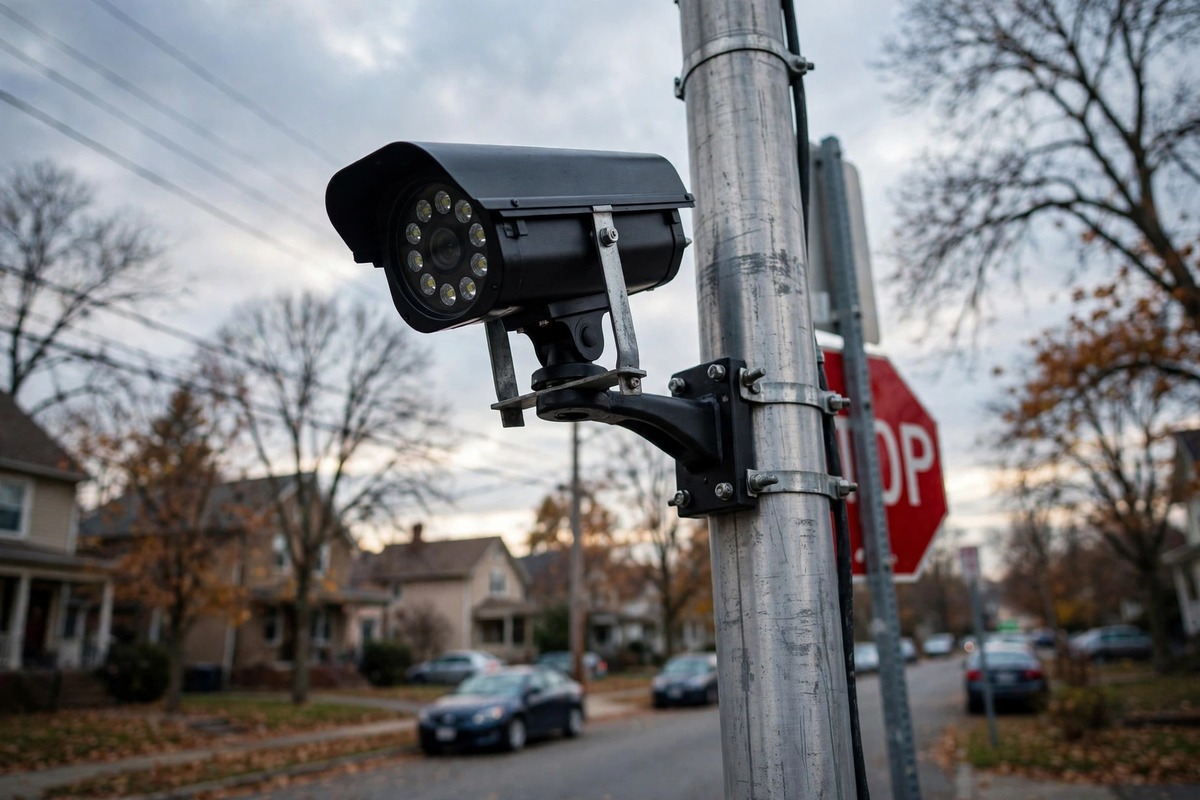
Monongalia County’s 20 Flock Safety cameras connect a small-county surveillance deal to a much wider law enforcement search network, according to the county contract and an audit reported by WV News.
The audit says the county’s camera data can be searched by 980 other law enforcement organizations. The contract also says deputies can reach a Flock network holding billions of license plate scans each month, although agencies outside West Virginia and beyond a 50-mile radius cannot search Monongalia’s network.
That means the cameras are not simply creating a local record of passing vehicles. They sit inside a system that can help officers look for cars across a broad area, raising immediate questions about who can search the information and under what limits.
The Search Can Start Without a Plate
Drug and narcotics cases accounted for 188 camera searches between Jan. 1 and June 25, more than any other category listed in the audit.
Flock’s Vehicle Fingerprint feature adds another layer. Officers can search for a car using details such as its make, color and other physical characteristics, even when they do not have the license plate number.
The Contract Gives Flock Broad Data Rights
Sheriff Todd Forbes signed the agreement in Nov. 2025. It commits the county to pay $177,600 over three years for the 20 cameras.
The contract also binds Monongalia County to Flock’s online terms. Those terms say the county remains the data owner, but grants Flock a worldwide, perpetual, royalty-free license to use and disclose the information to operate the service and help improve its products. The terms cited in the report are dated August 2026.
Flock says each customer owns the information collected by its own cameras. A company spokesperson told the Daily Caller News Foundation that Flock does not provide contract-specific details such as camera counts, locations or deployments, and said the customer agency is the best source for those answers.
Neither the Monongalia County Sheriff’s Office nor the county commission immediately answered requests for comment from the Daily Caller News Foundation.
A Local Deal Inside a Much Larger Footprint
The county’s cameras represent only a small part of Flock’s broader network. Cybersecurity researcher Joshua Michael mapped more than 300,000 devices in September.
Why It Matters
This arrangement matters because a purchase made for a county can function inside a much wider system. Residents may assume a camera installed near a local road serves a local investigation, yet the contract and audit describe access that reaches well beyond the county. That changes the privacy question. It is no longer only about what the sheriff’s office can see, but also about which outside agencies can search the data, what identifying details they can use, and how much control remains with the community that paid for the equipment.
The deal also exposes a tension between ownership and control. The county remains the data owner, while Flock receives continuing permission to handle the information for its services and product development. That may be acceptable to some officials as a crime-fighting tool, but it raises a practical question for the public: what limits are meaningful when the system can search by a vehicle’s appearance and connect local records to a much larger network? The audit, the lack of immediate local responses and the competing federal proposals show that the debate is still unresolved.
Lawmakers Push Back From Both Parties
The concern has moved beyond the county. Democratic Rep. Alexandria Ocasio-Cortez, Democratic Sen. Jeff Merkley and Independent Sen. Bernie Sanders introduced the Ban Flock Act, which would end the federal government’s use of license plate readers.
Sanders warned that America should not become a surveillance state in which powerful technology interests benefit from giving the government tools to track people’s movements.
We cannot allow America to become a surveillance state where AI oligarchs profit by giving the government the power to track our every movement.
That is why @AOC, @JeffMerkley and I are introducing the BAN FLOCK Act to block federal funding for automatic license plate readers.
— Bernie Sanders (@BernieSanders) October 2, 2026
Republican Rep. Greg Steube separately introduced a bill on Sept. 24 that would prevent federal agencies from searching Flock cameras without a warrant. He argued that technological progress does not erase Fourth Amendment protections and pointed to the risk of camera misuse.
THIS is the problem with Flock cameras!!
A Sarasota police officer was just arrested and fired following an investigation into the alleged misuse of Flock and other law enforcement databases.
When you give the government the ability to track people, someone WILL abuse it.
Our…
— Congressman Greg Steube (@RepGregSteube) August 20, 2026
Source: The Liberty Daily
